Skywatchers around the world can see the moon block out the sun via a live feed.

Sunday's event will be a rare hybrid eclipse.
Published November 1, 2013
The moon's dark shadow will glide across the
face of the sun on Sunday, November 3, giving most of equatorial Africa a
rare view of a total eclipse.
Skywatchers living along North America's east
coast and in northern South America, southern Europe, and the Middle
East, meanwhile, will still glimpse a partial eclipse. (See "Solar Eclipses.")
One of nature's most striking events, a total solar eclipse
only happens when the Earth, sun, and moon align perfectly. That allows
the moon to cast its center-most shadow, called the umbra, over the
entire face of the solar disk.
The resultant shadow is projected onto a very narrow strip along the surface of the Earth.
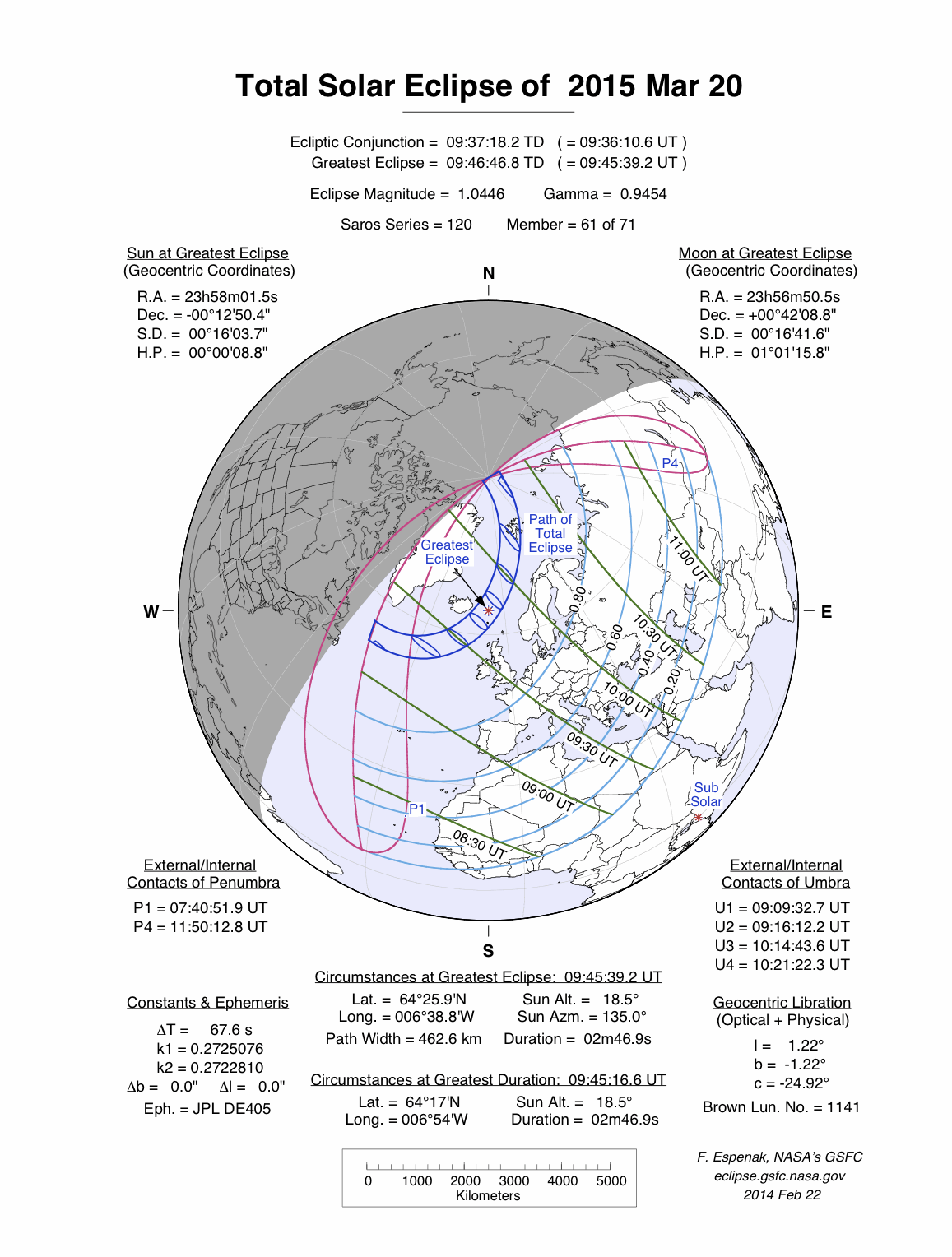
Total solar eclipses occur only every few years; the most recent one was on November 12, 2012, over the South Pacific. The next one after this weekend comes in 2015 over the North Atlantic.
This year's event is a rare hybrid eclipse, where for
part of the the event, the sun's light is not completely covered. Such
events, called annular eclipses, are dangerous to watch directly (learn
more about them below).
Weekend Solar Eclipse
On Sunday, over the course of just 3.3 hours, that lunar shadow touches down 620 miles (1,000 kilometers) east of Jacksonville, Florida, at sunrise.
The path of the totality—where the entire solar disk
is covered—then races across the open North Atlantic Ocean and through
central Africa until the lunar shadow leaves the Earth's surface in
Somalia at local sunset.
In total the moon's shadow will have traveled along a
path approximately 8,450 miles (13,600 kilometers) across the globe.
The totality in Gabon will last about a minute, while in Kenya it will
be only be a scant 11 seconds long.
Armchair Astronomy
Though the most dramatic parts of this celestial
phenomenon will only be visible in remote areas of central Africa,
armchair astronomers can watch a live webcast of the eclipse by
SLOOH.com.
The online observatory will provide multiple feeds
beamed from the African continent along the path of totality, including
coverage from Kenya, Gabon, and the Canary Islands off the coast of West
Africa.
The broadcast will start on November 3, starting at 6:45 am EST (11:45 GMT) and ending at 10:15 am EST (15:15 GMT). (See a list of cities and times.)
North Americans should take note that Daylight Saving
Time ends on the same day as the eclipse, at 2 a.m. Sunday morning
local time.
"It is always astonishing to see the moon apparently cut bites out of the sun," said eclipse expert Jay Pasachoff,
Field Memorial professor at Williams College in Massachusetts and a
National Geographic explorer who will be in Gabon to observe the event.
"And it is a wonder of modern science and mathematics
that you can travel halfway around the world, arriving on a normal day
with blue sky, but then, on schedule, the lunar silhouette breaks up the
sunlight."

কোন মন্তব্য নেই:
একটি মন্তব্য পোস্ট করুন